

Pain Relief Machine for Ageing Parents: A Guide to Caring for Parents When Away From Home
Quick Summary
Living in another city changes what support you can realistically offer a parent in daily pain. This guide covers how to assess what they are actually dealing with, the safety checks that have to happen before any device arrives, how to choose a pain relief machine they can operate without help, and how to build a routine that holds up when you are not there to prompt it.
The phone call is familiar. Your mother mentions her knees are bad again, then changes the subject. You are four hours away, or four time zones, and the gap between wanting to help and being able to do something useful is wide. Buying a device feels like action. It can be, but only if the choice accounts for the fact that nobody will be standing next to them when they use it.
What Caring From a Distance Actually Involves
Long-distance support looks different from hands-on care. It tends to mean coordinating rather than doing: organising deliveries and prescriptions, speaking to professionals on their behalf, keeping records straight, and arranging for someone local to check in. The organisation Carers First describes it as largely a matter of empowering the person to look after themselves while you handle the coordination around them.
That framing matters for this decision. Anything you send home needs to work with almost no support from you. A device that requires a video call every time it comes out is not a solution, it is another task.
Understand Their Pain Before Choosing a Pain Relief Machine
Older adults rarely have one clean complaint. Ask specific questions rather than "how are your knees", which tends to get a reassuring answer.
-
Where exactly does it hurt, and is it one place or several?
-
When is it worst, first thing in the morning or by the evening?
-
Does it stop them doing something they used to do?
-
What are they already taking, and how often?
-
Have they seen a GP or physiotherapist about it?
That last question is the important one. For osteoarthritis, which is the most common cause of joint pain in this age group, NHS describes exercise as one of the most important treatments, alongside maintaining a healthy weight. Any device sits alongside that. If your parents have never had the pain properly assessed, arranging that appointment is worth more than anything you can order online.
The Safety Checks That Come First
These need answering before you buy, not after delivery. Electrical stimulation is not suitable for everyone, and your parents may not volunteer the relevant history.
-
Implanted devices: A pacemaker or any implanted electrical device rules out use without specialist advice.
-
Metal implants: Joint replacements, plates and pins all need checking first.
-
Existing conditions: Epilepsy, cancer and serious heart conditions are all listed contraindications.
-
Skin condition: Pads should never go on broken, inflamed or fragile skin.
-
Sensation: Where feeling is reduced, as often happens with diabetic neuropathy, they may not notice if the intensity is too high.
NHS guidance warns that using TENS over areas where skin is numb can cause burns, so the first session should be supervised if at all possible. Time it for a visit, or ask a sibling or neighbour to sit with them.
Choosing a Machine They Can Use Alone
This is where most purchases go wrong. Devices that need electrode pads positioned correctly on the back put a decision in front of someone who is on their own and unsure, and the usual outcome is that the box goes into a cupboard.
| Consideration | Nerve & Muscle Stimulator (NXT) | Knee Pulse |
|---|---|---|
| Technology | TENS and EMS, selected as P2 and P1 | TENS |
| Setup | Feet on the platform, or four electrode pads for back, legs and arms | Straps around the knee, gel applied first |
| Session | 30-minute built-in timer | 15-minute session |
| Adjustment | 99 intensity levels, remote included | 30 intensity levels, 3 therapy modes |
| Best suited to | Pain across several areas, or feet and legs | A single stiff or aching knee |
For a parent managing pain in more than one place, the dual-mode TENS and EMS unit is the more practical choice, mainly because of the foot platform. They sit down, place their feet, and press start. There is no placement decision to get wrong. The included remote means they are not bending down to adjust the intensity mid-session, which matters more than it sounds when hips and backs are the problem. It is CDSCO approved as a Class B device.
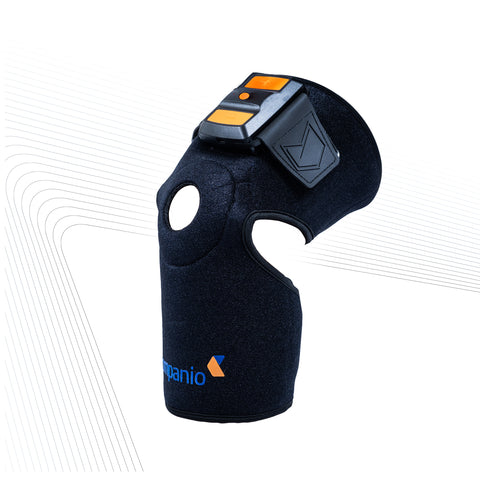
Where the trouble is confined to one knee, a wearable is simpler still. Knee Pulse straps around the joint and runs a 15-minute session, with electrode gel included in the box. As a joint pain relief machine it removes the pad positioning step entirely.
Building a Routine That Survives Your Absence
Buying the device is the easy part. Getting it used regularly is the work.
-
Anchor it to something that already happens: After the evening meal or before the news works better than a vague instruction to use it daily.
-
Set the intensity together on the first call: Find a comfortable level and write it on a card kept with the device.
-
Ask about it specifically: "Did you use it yesterday" gets a more useful answer than "how is the pain".
-
Recruit someone local: A neighbour or relative who can troubleshoot a flat battery saves weeks of quiet non-use.
-
Check the skin occasionally: Ask them to look for redness after sessions and tell you if it appears.
Knowing When to Escalate
A device is for managing ongoing discomfort, not for waiting out something new. Encourage your parent to see a GP if pain worsens, changes character, or arrives with swelling, numbness, weakness or unexplained weight loss. Any sudden severe pain after a fall needs assessing the same day. Make sure they know you would rather they called you about a false alarm than sat on something for a fortnight.
Conclusion
Distance limits what you can do, but it does not stop you doing the two things that matter most: making sure the pain has been properly assessed, and choosing support your parent can manage without you. Pick the device for ease of independent use rather than feature count, set it up with them once, and build the follow-up into calls you were making anyway.
Frequently Asked Questions
1. Can an elderly parent use a pain relief machine on their own?
Many can, provided contraindications are cleared and the device is simple. Foot-platform and wearable designs need no pad positioning, which removes the step people most often get wrong.
2. What should I check before buying one?
Confirm there is no pacemaker, implant, epilepsy, cancer or serious heart condition, and that the skin is intact with normal sensation in the target area. Check with their GP if anything is uncertain.
3. How long should sessions last?
It varies by device. The NXT runs on a 30-minute timer and Knee Pulse on a 15-minute cycle. Starting with one session a day is sensible.
4. Will it replace their medication or physiotherapy?
No. It is a supporting measure. Never adjust prescribed medication without speaking to the prescribing doctor.
5. What if they say it is not helping?
Response varies between individuals. Check the intensity is high enough to feel clearly, give it a few consistent weeks, and if there is still no benefit, raise the pain itself with their GP.